


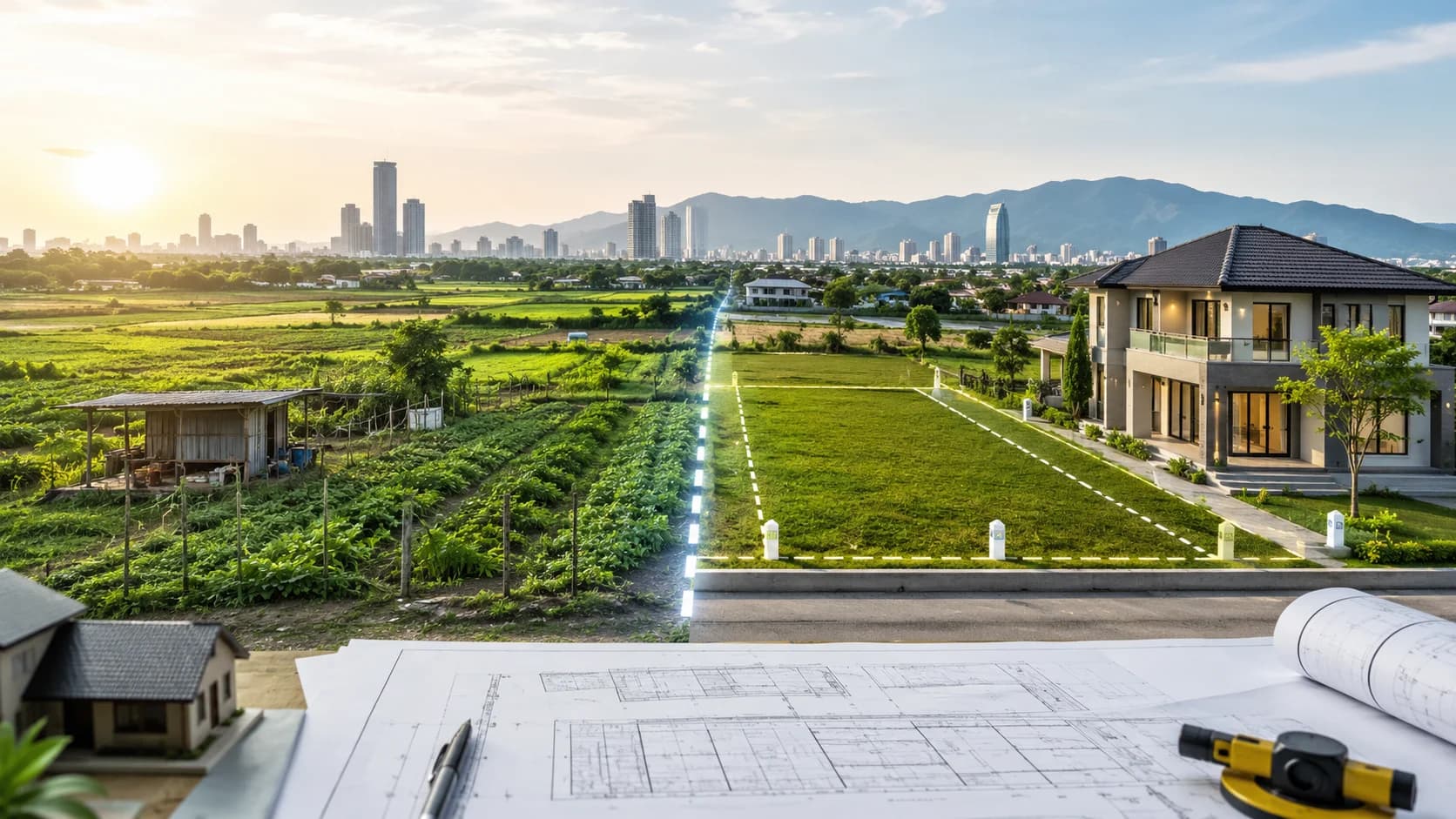
The need to convert garden land, perennial crop land or other types of agricultural land into residential land usually arises when people want to build a house, split off land for their children, unlock the value of their assets or complete their paperwork before a transfer. However, not every land plot for which there is such a need will be approved for a change of land use purpose by the state authorities.
Before carrying out the procedure for changing the land use purpose in Da Nang, land users need to check the planning, the origin of the land, the type of land currently recorded, the area proposed for conversion, any dispute status and the financial obligations that may arise. In particular, from 2026, the policies on the authority to handle applications and on land use levies have undergone notable changes under Resolution No. 254/2025/QH15, Decree No. 49/2026/ND-CP and Decree No. 50/2026/ND-CP.
What is a change of land use purpose?
A change of land use purpose is the conversion of the type of land currently in use to a different purpose in accordance with the law. The most common case for individuals is converting agricultural land, garden land, pond land or crop land into residential land.
It is necessary to distinguish between the actual use of the land and the purpose recognized by law. The fact that someone has built a house on agricultural land does not mean that the land automatically becomes residential land. Where permission is required, the land user may only use the land for the new purpose after a decision has been issued by the competent authority and the related obligations have been fulfilled.
Building a house or using land for a purpose other than the one stated on the Certificate without authorization may result in administrative penalties and an obligation to remedy the consequences, and may create difficulties for a later application to change the land use purpose.
When is permission required to change the land use purpose?
Not every change in the course of using the land requires permission. However, converting agricultural land into non-agricultural land, especially into residential land, falls into the category of applications that must be reviewed and approved by the competent authority.
The handling authority does not only examine the application form but also considers many factors, such as:
- The current land use purpose;
- The planning applicable to the area;
- The origin and legal documents of the land plot;
- The area proposed for conversion;
- The actual state of land use;
- Specific conditions applicable to rice land, forest land or special types of land;
- The ability to fulfil financial obligations.
Therefore, the fact that a land plot is located near a residential area or is already surrounded by houses is not enough to say with certainty that the application will be approved.
What are the conditions for converting agricultural land into residential land in Da Nang?
When converting agricultural land into residential land in Da Nang, the first issue to check is the planning and whether the land plot can be used for residential purposes. Next come the legality of the land use rights, the current state of the boundaries, the area, the origin of use and any existing restrictions.
In practice, an application may run into problems when:
- The information on the Certificate does not match the actual state of the land;
- The actual area differs from the cadastral records;
- The land is under dispute or is used jointly by several people;
- The land plot is mortgaged but there is no arrangement yet for coordination with the bank;
- Part of the area falls within the planning for public works;
- The land user has built a house before being permitted to change the land use purpose.
From a legal perspective, it is advisable to check the documents before filing rather than relying solely on word of mouth that "many people in that area have already converted their land to residential." Each land plot has a different origin, location and legal status, so the outcome for an adjacent plot does not automatically apply to your own.
What documents are required to change the land use purpose?
The specific components of the application must be checked against the administrative procedure currently applicable in Da Nang. Typically, land users need to prepare:
- An application for permission to change the land use purpose;
- The Certificate of land use rights;
- Legal documents of the land user;
- Authorization documents if the procedure is carried out through a representative;
- Documents on the current state of the land, survey results or a cadastral map extract if requested by the handling authority;
- Documents proving eligibility for exemption from or reduction of financial obligations, if any.
Decree No. 49/2026/ND-CP assigns provincial-level People's Committees to specify the process, maximum processing time, application components and forms for land procedures in their localities. This regulation also requires the procedure to be made public on the local government's portal.
Procedure for changing the land use purpose in Da Nang
The usual process can be summarized in the following stages:
Step 1: Review the legal documents and planning
Before filing, it is necessary to correctly identify the current type of land, the area to be converted and whether it is consistent with the planning. This step determines whether or not it is worth proceeding.
Step 2: Prepare and submit the application
The land user prepares the application form, the Certificate and related documents, then submits them to the receiving authority in accordance with the city's regulations.
Step 3: Site inspection and appraisal
The specialized agency reviews the application and may carry out on-site verification, surveying, or request additional documents if the information is inconsistent.
Step 4: Issuance of the decision permitting the change of land use purpose
If the application meets the conditions, the competent authority issues a decision permitting the change of land use purpose.
In Da Nang, Decision No. 91/2026/QD-UBND has delegated certain land-related tasks to the Chairperson of the commune-level People's Committee, including deciding on permission to change the land use purpose in the cases specified in Clause 2, Article 123 of the Land Law.
Step 5: Determine and fulfil financial obligations
The file is forwarded to the tax authority to determine the land use levy and other amounts payable. The land user needs to pay according to the notice within the prescribed time limit.
Step 6: Update the Certificate
After the financial obligations have been fulfilled, the new land use purpose is updated on the Certificate or in the cadastral records according to the relevant authority. Decree No. 49/2026/ND-CP also provides that the Chairperson of the commune-level People's Committee may issue or certify changes on the Certificate in cases where the commune level decided to permit the change of land use purpose.
How to calculate the fee for converting garden land to residential land
This is the issue clients are most concerned about. In principle, the land use levy is determined based on the difference between the price of residential land and the price of agricultural land, multiplied by the area and the corresponding collection rate:
Estimated land use levy = Payable rate × (Residential land price – Agricultural land price) × Converted area.
The land prices are taken from the land price list applicable at the time the competent authority issues the decision permitting the change of land use purpose. As a result, two land plots of the same area but on different roads, in different locations or of different original land types may have very different financial obligations. Da Nang issued its regulations and land price list for the city in 2026, serving as the basis for handling financial obligations in cases where the land price list applies.
Under the policy effective from 2026, for households and individuals converting garden land, pond land or agricultural land into residential land who meet the conditions to benefit from the policy, the collection rate is determined as follows:
- 30% of the difference for the area within the residential land allocation limit;
- 50% of the difference for the area exceeding the limit but not more than one times the limit;
- 100% of the difference for the area exceeding one times the limit.
However, this preferential method of calculating the fee for converting garden land to residential land may only be applied once for each household or individual, on one land plot of their choice. Subsequent conversions, or conversions of other land plots, may be subject to 100% of the difference.
Therefore, you should not estimate the amount yourself simply by multiplying the area by the residential land price. To obtain a reasonably accurate estimate, it is necessary to determine at the same time the type of land, its location, the residential land allocation limit, the area applied for conversion and whether the land user has previously benefited from this policy.
Common risks when handling the application yourself
Some common problems include filing before checking the planning, applying to convert an unsuitable area, using the wrong application form, lacking documents on land use rights, or failing to anticipate the financial obligations.
In particular, where only part of a land plot is to be converted, it is necessary to additionally check the requirements on surveying, plot subdivision and minimum area. Current law has separate provisions for land plots that include both residential land and other types of land; in some cases, converting part of a plot does not require subdivision if the land user has no need to subdivide.
Land use conversion services at HLR Legal Vietnam
HLR Legal Vietnam provides services for changing the land use purpose in Da Nang with an approach of checking the conditions before agreeing to handle the application. The scope of support may include:
- Reviewing the Certificate and the origin of land use;
- Checking planning information;
- Assessing the feasibility of changing the land use purpose;
- Determining the appropriate area to apply for conversion;
- Estimating the method of calculating the land use levy;
- Preparing the application and acting as representative in carrying out the procedure;
- Following up on requests for supplementary documents, financial obligations and the updated results;
- Advising on combining the change of land use purpose with plot subdivision or amendments to the Certificate.
The value of the service does not lie only in submitting a set of documents. More importantly, it helps clients know in advance which points are not yet compliant, what financial amounts may arise and which risks need to be addressed before the state authorities review the application.
This content is for reference only and does not replace formal legal advice from a lawyer or a competent authority.